Configuration revisions
With config.ui = "managed", the gateway keeps its configuration as a
history of revisions in a store, and you save, compare, apply and roll back
revisions on the admin listener. With config.ui = "off", the default, none
of this exists: the gateway is configured by its file and the FERROFED__
environment alone, opens no store, and serves no revision route. No
specification governs this page: our own design.
What is built is the revision store and its API on the admin listener (#576), the members and stored queries the operator console manages, with their owners (#577, Console-managed resources), and the onward credentials and binding sections it manages, with write-only secrets, a confirmation after a change applies and a second operator’s approval before it applies (#578, Credentials and binding sections). Any revision exports as TOML, and TOML imports as a dry-run revision (#579, Export and import).
Turning it on
[metrics]
listen = "127.0.0.1:9464"     # the admin listener, which serves the revisions

[config]
ui = "managed"                # "off", the default, changes nothing
backend = "redb"              # or "postgres", for replicas that share a store
path = "/var/lib/ferrofed/config-revisions.redb"   # redb: the store file
# url_file = "/run/secrets/ferrofed/config-revisions-url"   # postgres: the connection string, a secret
| Key | Default | What it sets |
|---|---|---|
config.ui | off | managed keeps the configuration as revisions on the admin listener |
config.backend | redb | redb, an embedded file one gateway process opens at a time, or postgres, one database every replica shares; postgres needs a build with the postgres feature |
config.path | none | the redb store file, created when it does not exist |
config.url, config.url_file | none | the PostgreSQL connection string of the postgres backend, a URL or libpq key/value pairs; a secret, never logged, and its sslmode must be require when it carries a password over a network outside the development profile |
Under off, GET /admin/config answers 404 configuration-unmanaged, so a
client tells an unmanaged gateway from a wrong admin URL. Under off, any other key of [config] refuses to start, so a store you
meant to use is never silently ignored. Under managed, [metrics] listen
must be set, since the revision API is served on the admin listener.
What a revision holds
A revision is the whole configuration less its bootstrap core: the file and the environment as the gateway reads them, written as TOML text. The bootstrap core comes from the file alone and is never part of a revision:
| Bootstrap core | Why it stays in the file |
|---|---|
profile | it decides the transport policy every outbound URL is held to |
[server] | the client listener: its address, TLS, base path and limits |
[metrics] | the admin listener and its scrape authentication |
[auth] | client authentication, the operator scope among it |
[config] | the revision store itself |
[dev] | the development cross-reference pairs patient identifiers with ehr_ids, which no store holds |
So a revision can neither lock you out of the admin listener nor lower the security floor the file sets. A revision that sets a key of the core is refused.
A revision never holds a secret value. Under managed, every secret
outside the core is written as its _file reference, such as
password_file, and the gateway refuses to start, and refuses a
revision, that writes one inline (password, client_identity,
client_secret, assertion, stored_queries.url, or a URL that carries a
password). The refusal names the key, never the value. A secret inside the
core, such as an [[auth.basic.users]] password_hash, may stay inline, since the core is never stored.
Comments are not kept: a revision is stored as TOML writes it.
Each revision records its number, the revision it was based on, where it
came from (file, operator, rollback or import), who made it (the file, or the
operator’s issuer and subject as their token names them), when, and why.
The file is a revision too
At start, and at each SIGHUP reload, the gateway reads its file and
environment and checks them as config check does. When the part a
revision holds differs from the newest revision the file gave, it is saved
as a new revision by the file and runs. When it does not, the revision
marked running keeps running, with the file’s bootstrap core beside it,
so a revision you applied survives a restart until you change the file.
Nothing ever writes back to the file.
Every revision is checked as config check checks the file
A revision is put beside the file’s bootstrap core, read as the
configuration, resolved, and checked as ferrofed config check checks a
file, the transport policy and the registry document included. One the
check refuses is refused with 422 configuration-invalid, and the message
carries the same error config check prints. Nothing is stored, and the
running configuration stays.
The routes
Every route is on the admin listener and is admitted only for a caller
whose token carries auth.product_scope, as the other admin
actions are (Who the admin listener serves).
Each write is recorded under ferrofed::security as an admin action, and
with the revision number as config-revision-saved,
config-revision-applied, config-rolled-back or
config-revision-imported.
| Route | Answer |
|---|---|
GET /admin/config | the newest revision’s number as head, and the running revision’s mark as current: its number, the one before it, whether it is applied or pending-restart with the keys a restart applies, who applied it and when, and the confirmation it awaits (awaiting) or received (confirmed); what the newest revision takes when it does not run, as review (Commit-confirm, Second-operator approval); and this replica’s own running, in_step and refused (Several replicas) |
GET /admin/config/revisions?offset=&limit= | one page of the history, newest first, at most 100 |
GET /admin/config/revisions/{id} | one revision |
GET /admin/config/revisions/{id}/diff/{other} | each dotted key that differs from id to other: added, removed or changed, with both values |
POST /admin/config/revisions | saves {"base": <newest>, "reason": "…", "toml": "…"}, 201 with the revision |
POST /admin/config/revisions/{id}/apply | applies the newest revision, with no body |
POST /admin/config/rollback | {"current": <running>, "reason": "…"}: saves the content of the revision that ran before the running one as a new revision, and applies it |
GET /admin/config/revisions/{id}/export, POST /admin/config/import | a revision as TOML, and TOML saved as a dry-run revision (Export and import) |
A save names the revision it is based on, which must be the newest (null
for none), and an apply names the newest revision. When another operator,
or another replica on a shared store, saved or applied first, the request
is refused with 409 revision-stale and nothing changes, so two operators
never overwrite each other. Read the revisions again and base the change
on the newest one.
An apply goes through the same path as a SIGHUP reload: the sections a
reload applies take effect at once, and a changed setting that takes a
restart is listed in needs_restart, marked pending-restart, and takes
effect at the next start. When the reload refuses the revision, the
running configuration and the running mark stay. A rollback is one step:
it restores the revision that ran before the running one, so a second
rollback returns to where you were. With no earlier revision it is refused
with 409 rollback-unavailable.
The other refusals are 400 body-invalid for a body that does not read,
whose parser message is never echoed, and 404 revision-unknown
(Gateway codes).
Console-managed resources
Each member of the federation, with its organisation and its endpoints, and
each stored-query version has one owner, which GET /admin/config/resources
names:
| Owner | Resource | Changed by |
|---|---|---|
file | a member the registry document provides; a stored query of the read-only definition files | the file alone, read-only in the console |
directory | a member the care services directory of [registry.mcsd] provides | the directory alone, read-only in the console |
console | a member a revision holds under [[registry.members]] | the console, through a revision |
gateway | a stored query of the reserved namespace eu.ferrofed.eehrxf | nobody |
store | a stored-query version in the stored-query store | nobody: a held version is immutable (§12.7, N44) |
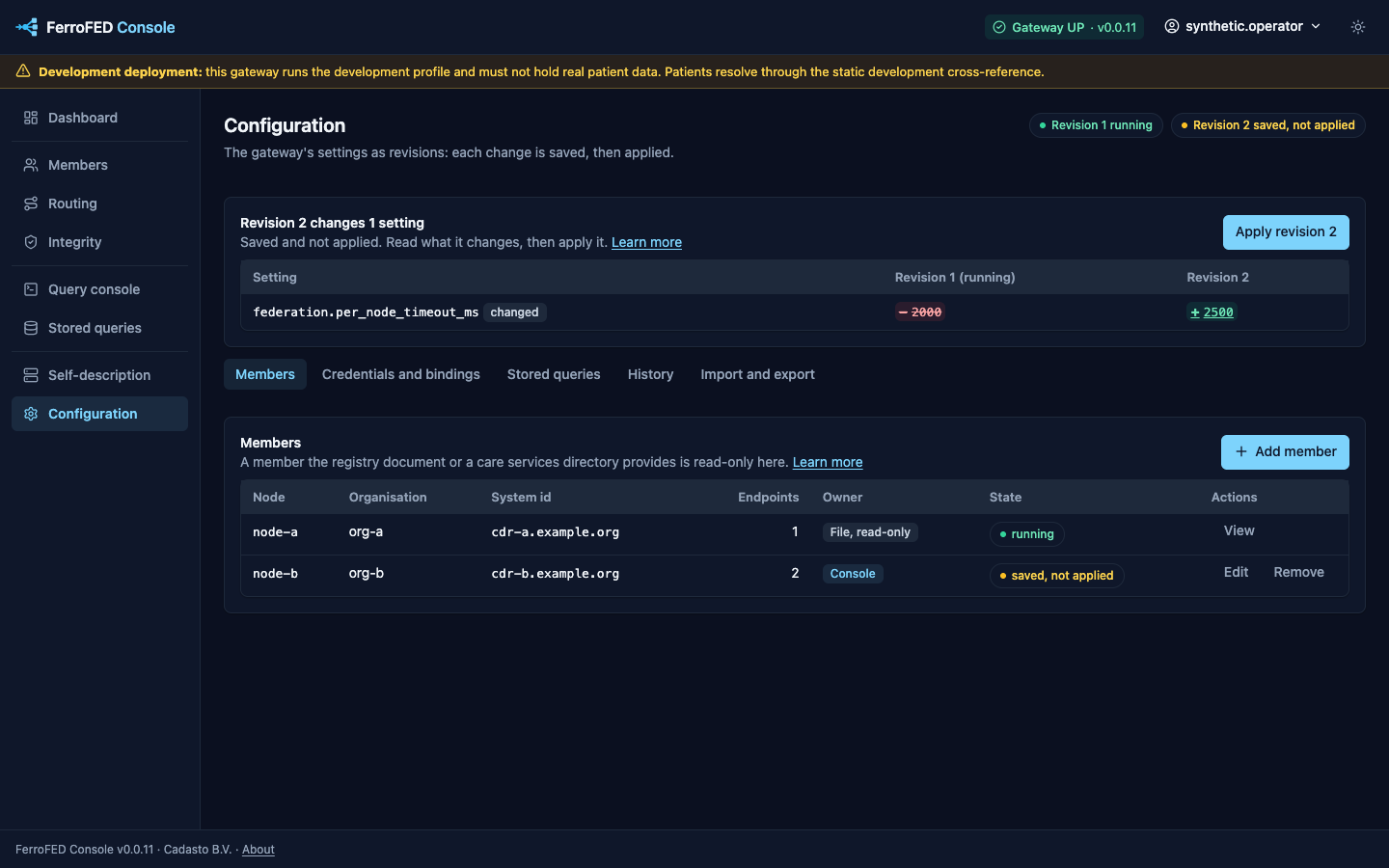
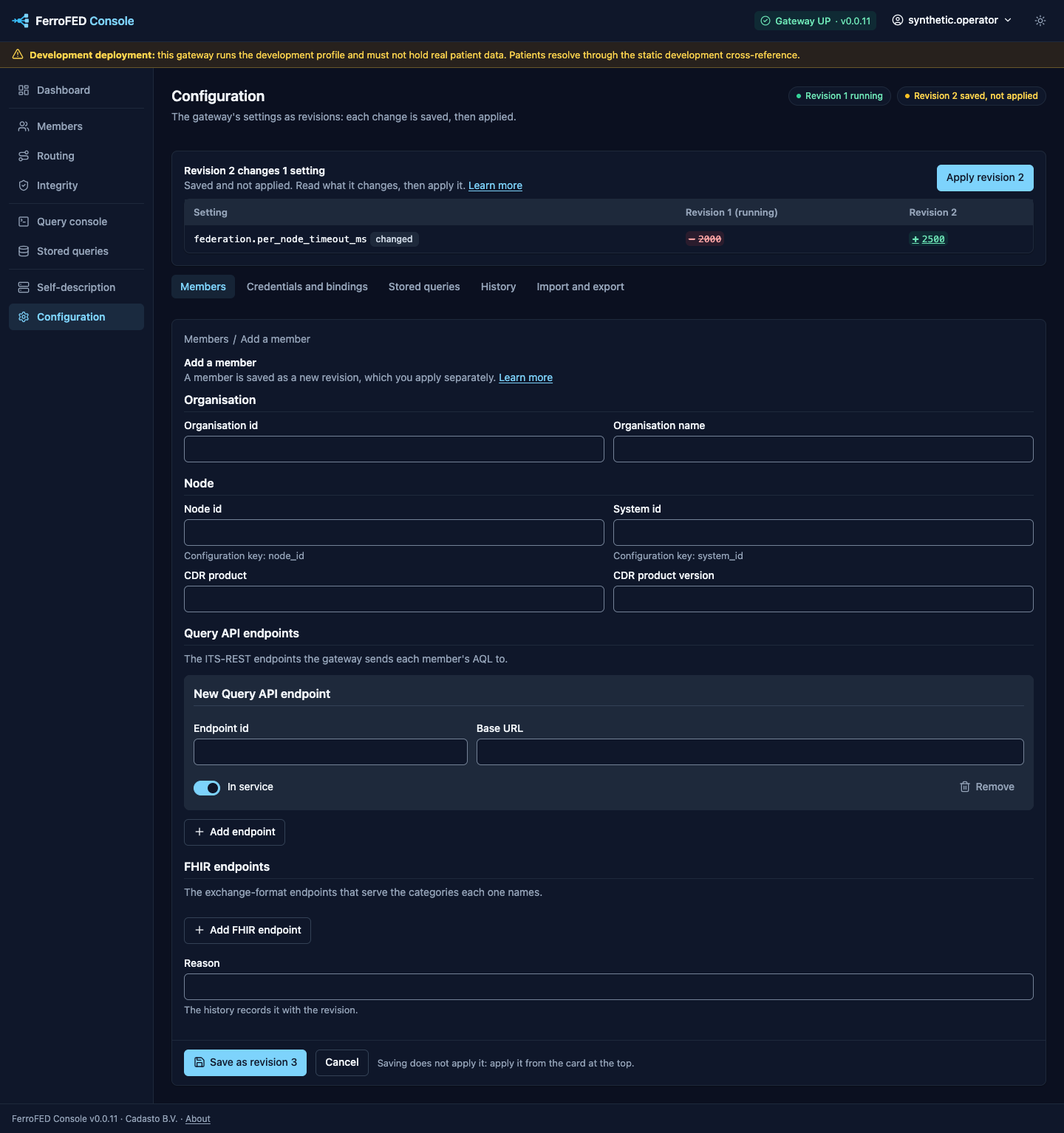
The console’s Members tab lists each member with its owner and state, and a console member is added on a form of its own (the console’s screens show every tab).
The Members tab in the dark theme
The member form in the dark theme
A member is owned whole. A console member is held in the revisions as one
[[registry.members]] entry and joined to the registry document’s members,
so a revision stays the whole configuration and nothing is written back to
the file. The configuration file and the environment never set
registry.members: a file that does refuses to start. Console members join
a registry document; with a care services directory, which is the whole
registry, they are refused.
[[registry.members]]
organisation = { id = "org-c", name = "Hospital C" }
node = { id = "node-c", system_id = "cdr-c.example.org", product = "FerroEHR", version = "4.3.3" }
endpoints = [
  { id = "node-c-pub", url = "https://cdr-c.example.org/openehr", connection_type = "openehr-rest-query" },
]
| Route | Answer |
|---|---|
GET /admin/config/resources | running and head, stored_query_registry (absent, read-only or writable), every member with its node, organisation, system_id, endpoints, owner, and for a console member its state and the member itself, and every stored-query version with its owner |
PUT /admin/config/members/{node_id} | {"base": <newest>, "reason": "…", "member": {…}}: saves a revision with the member in place of the console member of that node_id, or beside the others, 201 with the revision |
POST /admin/config/members/{node_id}/remove | {"base": <newest>, "reason": "…"}: saves a revision without that console member, 201 with the revision |
PUT /admin/config/stored-queries/{name}/{version} | {"aql": "…"}: stores the version in the stored-query store at once, 201 with it as an ITS-REST StoredQuery |
A member save or removal is not applied: preview the revision with
GET /admin/config/revisions/{running}/diff/{new}, then apply it, and roll
it back in one step like any revision. A console member’s state is
running, pending (saved, not applied), removing (the newest revision
removes it), or shadowed.
A change that names a member the file or the directory provides, by its
node_id, its organisation id, its system_id, an endpoint_id or an
endpoint’s base URL, is refused with 409 resource-file-owned, and the
removal of a node_id no console member has with 404 resource-unknown.
A stored-query version is admitted as a PUT to the ITS-REST definition
API is: a held version is 409 stored-query-held, the reserved namespace
409 stored-query-reserved, and the read-only definition files
409 resource-file-owned. A version is never edited or removed, so a
change is a new version.
At a SIGHUP reload whose file changed, the file’s new revision carries
the console members over from the running revision, so a console member
survives the reload. When the file later provides a member that shares an
identity with a console member, the file’s member runs, and the console’s
copy stays in the revision, reported as shadowed and logged by node_id;
remove it, or give it identities of its own. When the console members are
refused beside the file’s configuration, as when the file drops the
registry document they join, the file’s revision is recorded without them,
the refusal is logged by key, and the revision before it still holds them.
The operator console’s Configuration page shows all of this through the
first replica it is configured with: the running and the newest revision
with the newest one’s changes, the members and stored queries with their
owners, and the history, in tabs of their own. A console member is saved or
removed, the newest revision applied, the running one rolled back, and a
stored-query version stored, each removal, apply, roll back and store
confirmed in a step of its own
(The operator console). Its member
form writes the openehr-rest-query and hl7-fhir-rest endpoints, each a
row of its own fields.
Credentials and binding sections
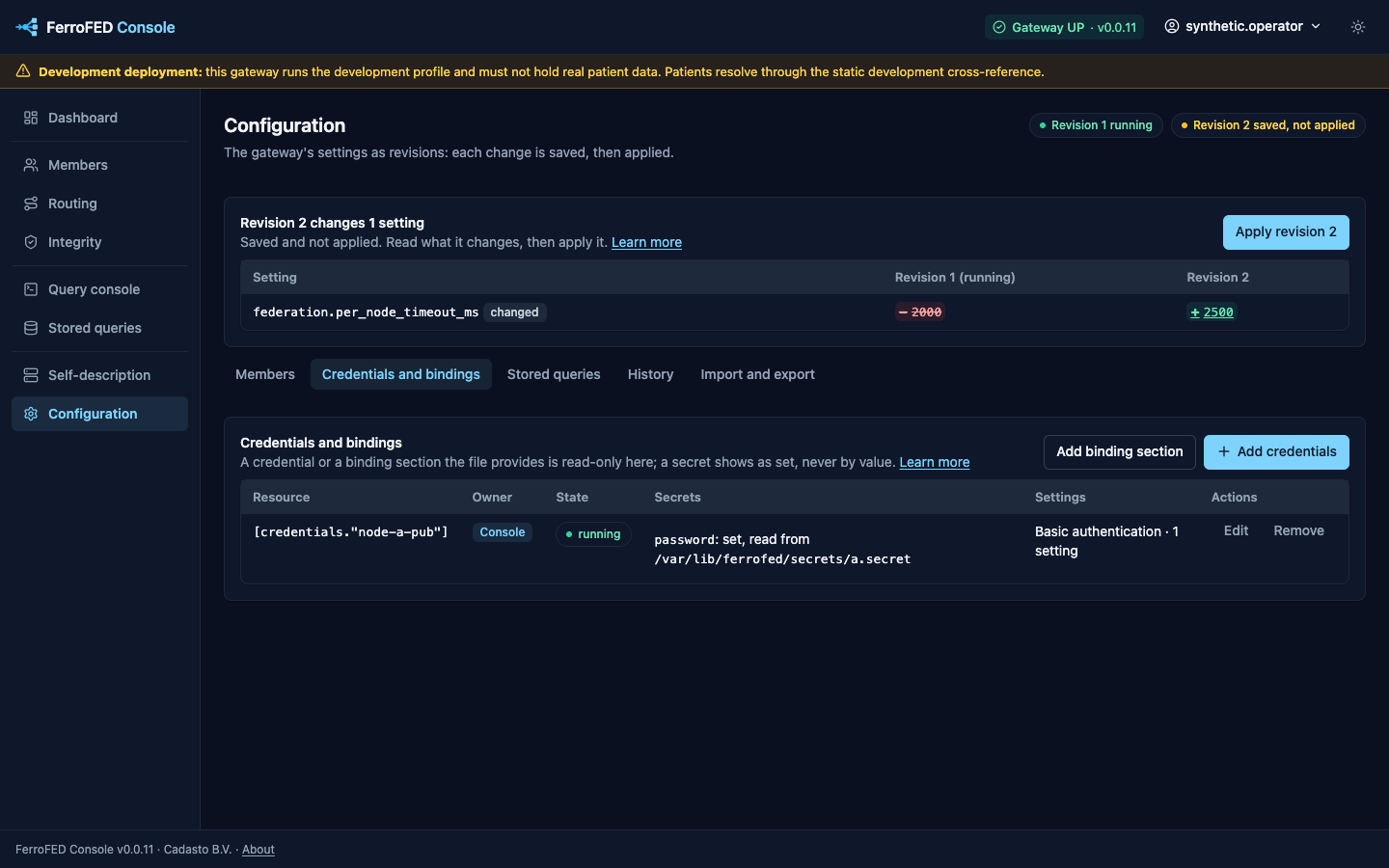
Each onward credential and each binding section is a resource owned whole, as a member is:
| Resource | Table | config.approval kinds |
|---|---|---|
| the onward credentials of one endpoint | [credentials."<endpoint id>"] | onward-credentials |
| the PIXm resolver | [pixm] | identity-services |
| the PDQm demographics step | [pdqm] | identity-services |
| the XCPD localizer | [xcpd] | identity-services, localization |
| the Dutch Generic Functions, the NVI localizer and the Mitz pre-filter | [nl_gf] | identity-services, localization, consent |
| the localization failure policy | [federation.localization] | localization |
| consent disclosure | [federation.consent] | consent |
The Credentials and bindings tab in the dark theme
The binding sections a build lacks, by its binding-ihe and binding-nl
features, are not offered. A resource the configuration file sets is the
file’s: GET /admin/config/resources names its owner as file, and a
change to it is refused with 409 resource-file-owned. Every other one a
revision sets is the console’s, and the revision records it in its
console list. Client authentication ([auth]), the transport policy the
profile sets and the rest of the bootstrap core stay in the file alone,
so the console cannot lock you out or lower the security floor.
| Route | Answer |
|---|---|
PUT /admin/config/credentials/{endpoint_id} | {"base": <newest>, "reason": "…", "settings": "…", "secrets": [{"key": "…", "value" | "file": "…" | "clear": true}]}: saves a revision with the endpoint’s credentials as given, 201 with the revision |
PUT /admin/config/bindings/{section} | the same body, for pixm, pdqm, xcpd, nl_gf, localization or consent |
POST /admin/config/credentials/{endpoint_id}/remove, POST /admin/config/bindings/{section}/remove | {"base": <newest>, "reason": "…"}: saves a revision without it, 201 with the revision |
settings holds the resource’s keys less its secrets, as the table’s own
keys or as one TOML inline table: { oauth = { token_endpoint = "https://as.example.org/token", client_id = "ferrofed", client_auth = "private_key_jwt", private_key_file = "/run/secrets/ferrofed-client.pem", scope = "system/aql-*.s" } }.
Settings that name a secret or its _file reference are refused with
400 body-invalid, naming the key. GET /admin/config/resources lists
each credential and binding section under sections, with its owner,
its state for a console one (running, pending or removing), its
settings as one inline table for a console one, and its secrets, each
a key and the reference it is read from; and the binding sections this
gateway is built with under bindings.
At a SIGHUP reload whose file changed, the file’s revision carries the
console’s credentials and binding sections over from the running revision.
A credential or a section the file now sets is the file’s from then on:
its console copy is left out of the file’s revision, and the gateway logs
its table.
A reload applies the credentials, the binding sections whose reload
applies ([pixm], [pdqm], [xcpd], [nl_gf]), the consent reporting
of [federation.consent], and the localization policy of
[federation.localization] while node_selection and the budgets are
those the process started with; a change to XCPD’s audit takes a restart,
as before.
Secrets are write-only
A revision never holds a secret value, only the _file reference to the
file it is read from. A secret change names the secret’s dotted key inside
the resource, such as password or oauth.client_secret, and one of:
file: the absolute path of a file the gateway reads, which the revision references as it is;value: the secret itself, which the gateway writes to a new file inconfig.secrets_dir, readable and writable by the gateway’s user alone (mode0600), and references. Each value gets a file of its own, never one that exists, so an earlier revision that references the previous file still reads it after a rollback. The gateway never logs the value, never echoes it, and never returns it in a revision, a diff, an export or an error;clear: the secret and its reference are removed.
A secret the change does not name keeps its reference. Without
config.secrets_dir, a value is refused with 409 secret-store-unavailable
and nothing is saved; a reference still works. A save the gateway refuses
removes the files it wrote for it. The files of earlier values stay in the
directory for the revisions that reference them; remove one once no
revision you may roll back to references it.
[config]
ui = "managed"
path = "/var/lib/ferrofed/config-revisions.redb"
secrets_dir = "/var/lib/ferrofed/secrets"   # an existing directory, on a volume every replica shares
Commit-confirm
An operator’s apply of a revision that changes an onward credential or a
binding section runs it awaiting a confirmation. GET /admin/config
shows the deadline and the resources it changed under current.awaiting.
Confirm it within config.confirm_ms, 120000 ms by default, once the
gateway works with it:
| Route | Answer |
|---|---|
POST /admin/config/revisions/{id}/confirm | with no body: the mark with the confirmation, its operator and time under current.confirmed |
Unless an operator confirms it by the deadline, the gateway rolls it back:
it saves the revision that ran before as a new revision, made by the
gateway with the reason revision N was not confirmed by its deadline,
applies it, and records config-unconfirmed-rolled-back under
ferrofed::security. Each replica reads the deadline from the store’s
running mark with every config.poll_ms read, so the first replica past
the deadline rolls it back and the others follow the rollback as any
applied revision. A gateway that starts with a revision past its deadline
rolls it back before it runs, and one that starts within the deadline keeps
waiting for the confirmation. A SIGHUP whose file changed while a
revision awaits its confirmation rolls that revision back first.
While a revision awaits its confirmation, another apply is refused with
409 confirmation-pending; confirm it or roll it back first. A
confirmation of a revision that does not await one, or past its deadline,
is refused with 409 confirmation-unavailable, and one from a caller with
no verified token, such as a loopback peer under the development profile,
with 403 operator-unverified. A rollback awaits no confirmation and takes
no approval: it restores what ran before. GET /admin/config shows what
the newest revision takes under review: the resources whose change awaits
a confirmation once it applies (confirms).
Second-operator approval
config.approval names the resources a revision changes only once an
operator other than its author approved it: a kind of the table above, or
one resource (credentials.<endpoint id>, pixm, pdqm, xcpd, nl_gf,
federation.localization, federation.consent).
[config]
approval = ["onward-credentials", "consent"]
| Route | Answer |
|---|---|
POST /admin/config/revisions/{id}/approve | with no body: what the revision takes, its approval resources and the approvals it holds, each with its operator and time, and whether it is approved |
An apply of a revision that changes such a resource is refused with
409 approval-required until an operator with another subject, at the
same or another accepted issuer, approved it. Its author’s approval is
refused with 403 approval-own-revision, the approval of a revision that
needs none with 409 approval-not-required, and one from a caller with no
verified token with 403 operator-unverified. The revision records its
author and the store records each approval with its operator, and both
are logged under ferrofed::security (config-revision-approved).
GET /admin/config shows the newest revision’s review, with its
author, its approval resources, its approvals and whether it is
approved.
| Key | Default | What it sets |
|---|---|---|
config.confirm_ms | 120000 | how long an applied change to a credential or a binding section awaits its confirmation, from 1000 to 3600000 ms |
config.approval | none | the resource kinds and resources a revision changes only with a second operator’s approval |
config.secrets_dir | none | the existing directory a secret value is written to; without it the console sets a secret by a reference alone |
Each is read only under managed, refused under off, and takes a
restart to change.
Export and import
Any revision exports as TOML, and TOML imports as a dry-run revision, so a configuration moves between the console and version control (#579).
| Route | Answer |
|---|---|
GET /admin/config/revisions/{id}/export | the revision as TOML, Content-Type: application/toml, as the attachment ferrofed-revision-{id}.toml with Cache-Control: no-store |
POST /admin/config/import?base=<newest>&reason=<text> | saves the TOML body as a revision on base, 201 with {"revision": …, "diff": …}: the revision, and each key it changes against the running revision, as the diff route writes them |
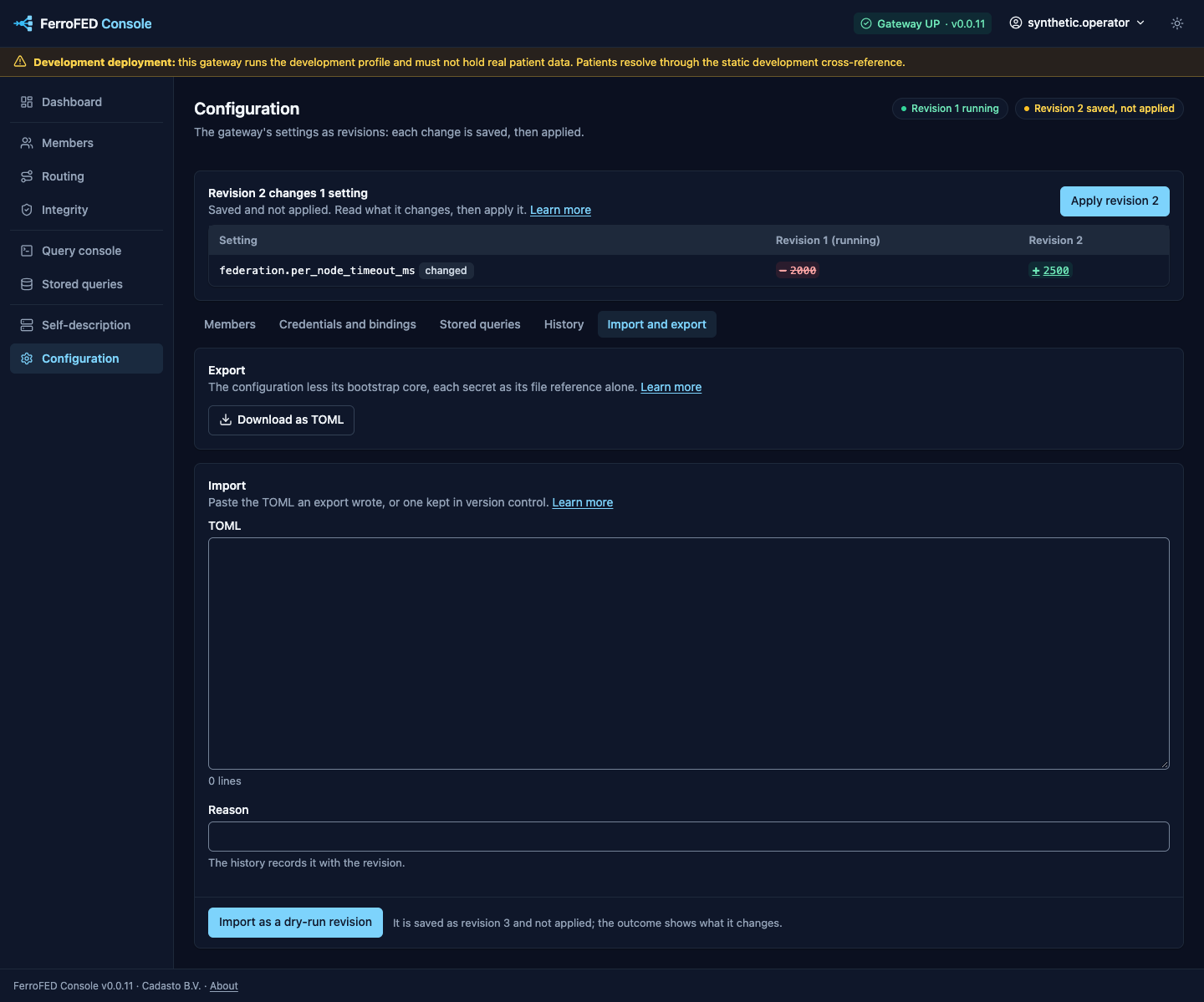
The Import and export tab in the dark theme
The export is the revision’s TOML text under a comment header that names
the revision, who made it, when, and where it came from. It holds the whole
configuration a revision holds, the console’s members, credentials and
binding sections beside the file’s, and every secret as its _file
reference. A secret the console wrote to config.secrets_dir is exported as
the path of the file it wrote. The bootstrap core is not part of a revision,
so it is not exported, and the header says so: keep the core in your file.
An import takes a body of Content-Type: application/toml (or text/plain)
of at most 1048576 bytes, and is checked as every save is. It is recorded
with the origin import, by the operator who sent it, for the reason the
query gives, and it is never applied by the import itself. Read the diff in
the answer, then apply it with POST /admin/config/revisions/{id}/apply,
which takes the approval and the confirmation it needs as any revision
does. An import is refused, and nothing is saved, when:
| The import | Refusal |
|---|---|
| sets a key of the bootstrap core | 422 configuration-invalid, naming the key |
| holds a secret inline | 422 configuration-invalid, naming the key, never the value |
| sets a credential or a binding section the file provides otherwise than the file does, or leaves it out | 409 resource-file-owned |
holds a console member that shares an identity with a member the registry document or a directory provides, and that base does not hold as it is | 409 resource-file-owned |
| is based on a revision other than the newest | 409 revision-stale |
| is sent as another media type | 415 media-type-unsupported |
| names no reason, or is larger than 1048576 bytes | 400 body-invalid |
Each import is recorded under ferrofed::security as
config-revision-imported with its revision number. An export of a
revision imports as the same configuration: its revision holds the same
TOML, and its diff against the revision exported is empty.
On the Configuration page each revision of the history offers its download (Export revision N as TOML), which the console’s server reads from the first replica with your access token and answers as an attachment. The form Import a configuration as TOML takes the TOML pasted into it, saves it as a dry-run revision, and shows what it changes; apply it with the form Apply revision.
File-first and console-first
Two ways of working use the same revisions:
- File-first: the configuration lives in version control and reaches
the gateway as its file. Each
SIGHUPreload or start records the file as a revision by the file, and its credentials and binding sections are the file’s, read-only in the console. Use the console to read the history and the diffs, and to roll back. - Console-first: the file holds the bootstrap core and little else, and operators change the configuration on the Configuration page or the admin routes. Export a revision to keep it in version control or review it as a pull request.
To move from console-first to file-first, export the running revision,
copy its tables into your file beside the bootstrap core, and reload: the
file then sets those credentials and binding sections and owns them.
Console members are the exception: the file never sets
registry.members, so move each one into the registry document. Secrets
stay as the _file references the export names; keep those files in
place.
To move a credential or a binding section from file-first to console-first, export the running revision, remove the section from the file and reload, then import the export: the file no longer provides the section, so the import sets it as the console’s, and you apply it as any revision. A configuration kept in version control comes in the same way, as an import you preview and apply, as long as it leaves every resource the file provides as the file sets it.
Several replicas
With backend = "postgres", the replicas share the history and the
running mark, and a save or an apply on one replica is checked against
what every other replica wrote.
Each replica reads the running mark every config.poll_ms, 5000 ms by
default. When the mark names a revision the replica does not run, because
another replica applied or rolled back a revision, or recorded its changed
file at a SIGHUP, the replica applies that revision through the same
reload path an apply takes. Within one poll_ms of an apply, every replica
runs the revision. The watch reads the mark with an ordinary query; it does
not use PostgreSQL LISTEN/NOTIFY.
A replica can refuse a revision another replica applied, for example when
a file the revision names, such as the registry document, is missing or
invalid on that replica. The replica then logs the refusal, counts it in
ferrofed_config_revision_follows_total{result="refused"}, and keeps its
running configuration. It does not try the same revision again. Fix the
cause, then send it SIGHUP or apply a newer revision.
GET /admin/config on each replica says where that replica stands:
| Member | Meaning |
|---|---|
running | the revision this replica runs, or null before the first one |
in_step | whether running is the revision the store marks current |
refused | the revision this replica refused, while it does not run it |
ferrofed_config_revision_in_step is 1 while the replica runs the
current revision and 0 while it does not, and the alert
FerroFEDConfigurationDrift fires after 10 minutes at 0
(Metrics).
| Key | Default | What it sets |
|---|---|---|
config.poll_ms | 5000 | how often each replica reads the running mark, from 100 to 600000 ms; read only under managed, and a change takes a restart |
Under config.ui = "off" nothing is read: no store, no watch.
With several replicas, config.secrets_dir must be one volume every
replica mounts at the same path, since a revision names the file a secret
value was written to and every replica reads it when it follows the
revision. A replica that cannot read a file a revision references refuses
that revision, keeps its running configuration and reports it as
refused, as above.